936-856-7894


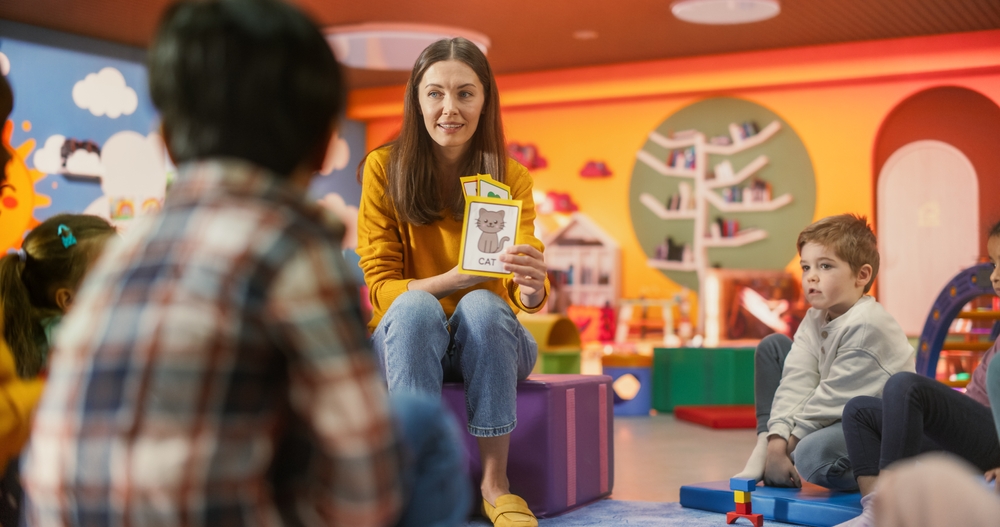
Keeping preschoolers interested throughout the day takes more than a list of activities. Young children learn through movement, play, exploration, conversation, and hands-on experiences, so effective classrooms give them different ways to participate and stay involved. Research from the National Association for the Education of Young Children (NAEYC) describes play as a central part of early learning, with children benefiting from a mix of self-directed play, guided play, and teacher-led experiences. So, what keeps preschoolers engaged? Teachers create varied experiences, build on children’s interests, offer meaningful choices, and use play as an opportunity to support learning.
Key Takeaways
- Preschool engagement comes from variety rather than nonstop instruction
- Play gives children opportunities to explore ideas and practice new skills
- Movement helps break up periods of sitting and focused learning
- Choices can give children a greater sense of ownership
- Teachers use observation and guidance to extend children’s learning
What Does Engagement Look Like in a Preschool Classroom?
Preschoolers can be engaged in learning in many different ways. They might build a tower with blocks, answer questions during a story, pretend to run a grocery store, sort objects by color, sing a song, paint a picture, or work with a classmate to solve a problem. Children learn best when they have opportunities to make choices, explore ideas, move, interact with others, and take an active role in what they are doing. Teachers can support that learning by offering guidance, asking questions, introducing new ideas, and building on children’s interests.
That distinction matters. A preschool teacher’s job is not simply to keep children busy. The goal is to create experiences that are interesting enough to invite participation while also supporting language, thinking, social development, movement, and other age-appropriate skills.
1. Teachers Mix Different Types of Activities
Imagine asking a four-year-old to sit through several long lessons in a row. Even when the subject is interesting, that approach is unlikely to hold their attention for an entire morning. Preschool teachers instead tend to vary the pace and type of experience throughout the day. A classroom might move from a group story to a hands-on activity, then to centers, outdoor play, lunch, or a quieter individual task.
This variety gives children different ways to participate. For example, a teacher might introduce shapes during group time, then invite children to find shapes around the classroom. Later, children could use blocks to create structures or draw pictures using different shapes. The underlying concept stays connected, but the way children interact with it changes.
2. Play Becomes Part of the Learning Process
To a parent, a child playing with blocks, pretending to cook, or dressing up as a firefighter may look like a break from learning. In a quality early learning environment, however, play can be an important part of the learning process. NAEYC explains that play allows children to explore their world, develop imaginative and symbolic thinking, and practice physical and social skills. Teachers can also use guided play to introduce learning goals without taking control of the child’s entire experience. A teacher might, for example, join children who are building with blocks and ask:
- How could you make your bridge stronger?
- Which block would you use for the bottom?
- What happens if we add another block?
- How many blocks did you use?
The children remain active participants while the teacher encourages them to think more deeply about what they are doing. This is one reason play and learning do not have to compete with each other in preschool.
3. Teachers Use Children’s Interests to Encourage Participation
Children are naturally more likely to participate when something catches their attention. A skilled teacher pays attention to those interests and looks for ways to connect them to classroom learning. If children become fascinated by insects they find outside, for example, that interest could lead to conversations about animals, counting activities, drawings, books, or a classroom observation project.
This does not mean abandoning the curriculum every time a child becomes interested in something new. Instead, teachers can use children’s curiosity as a starting point for introducing concepts. NAEYC describes effective educators as people who observe children’s interests and use those observations to shape learning environments and extend children’s play. That can make an activity feel more meaningful because children have a reason to care about what they are doing.
4. Hands-On Activities Keep Children Involved
Preschoolers generally benefit from opportunities to do something with what they are learning. Instead of only talking about numbers, a teacher might have children count objects. Instead of simply discussing colors, children might sort classroom materials or create artwork. Instead of explaining how structures work, a teacher might provide blocks and let children experiment.
Hands-on learning can also give teachers valuable information about what children understand. A child who struggles to answer a question verbally may demonstrate the concept successfully when given objects to manipulate. Another child may need additional prompts or a different way to approach the activity. The Lighthouse School’s preschool program reflects this balance by incorporating both child-initiated and teacher-planned activities, with hands-on experiences and learning centers forming part of the classroom experience.
5. Children Get Opportunities to Make Choices
Choice can be a simple but powerful way to encourage engagement. This might mean allowing children to choose:
- Which book they want to look at
- Which materials they want to use
- Which center they want to visit
- What they want to build
- Which role they want during pretend play
- Whether they want to draw, build, sort, or create
Choice does not mean that children decide everything that happens during the school day. Teachers still establish boundaries, routines, safety expectations, and learning goals. Instead, appropriate choices give children some ownership within those boundaries. NAEYC identifies children’s choice and active participation as important characteristics of effective development and learning.
6. Movement Is Built Into the Day
Preschoolers are not designed to spend an entire day sitting at a desk. Movement can be incorporated into learning in simple ways. Children might act out a story, dance to music, move like different animals, play an outdoor game, or participate in activities that require them to walk around the classroom. Movement can also provide a natural transition between activities.
For example, instead of simply telling children to move from one area to another, a teacher might turn the transition into a quick movement game. This gives children an opportunity to move while reinforcing classroom expectations. NAEYC notes that active movement can support children’s motivation and focus during play and learning.
7. Teachers Use Songs, Stories, and Conversation
Not every engaging activity requires special equipment. Songs, rhymes, stories, and conversations can hold children’s attention while supporting language and communication skills. A teacher might pause during a story and ask what a child thinks will happen next. Children might repeat a rhyme, sing a song with movements, or talk about something they noticed during the day. These activities also allow teachers to encourage children to express ideas rather than simply listen.
The CDC recommends reading with young children, asking questions about stories, encouraging conversation, and giving children opportunities to use language to communicate and solve problems. In the classroom, those same approaches can become shared learning experiences.
8. Teachers Balance Guided Learning With Child-Led Exploration
A common misconception is that preschool learning has to be either completely teacher-directed or completely free play. In practice, effective classrooms can use both. A teacher may introduce an idea, provide materials, ask questions, and establish a learning goal while allowing children room to explore. This approach is often called guided play. For example, if the learning goal involves shapes, the teacher could set up a “shape detective” activity. Children might search for shapes around the classroom while the teacher asks questions and encourages them to explain what they notice.
NAEYC describes guided play as a middle ground between child-directed play and direct instruction, allowing children to maintain ownership of the activity while teachers support deeper thinking. That balance can help prevent learning from feeling either overly restrictive or completely unstructured.
9. Teachers Adjust When an Activity Is Not Working
Even a carefully planned activity will not always go exactly as expected. Perhaps children finish sooner than anticipated. Maybe they become fascinated by something unrelated to the original lesson. Or the activity turns out to be too difficult or too easy for the group. Experienced teachers can adjust. They may shorten an activity, introduce a new question, change the materials, divide children into smaller groups, or provide an additional challenge for children who are ready for it.
This flexibility is particularly important because a classroom contains children with different personalities, interests, abilities, and levels of experience. The goal is not to make every child respond identically. It is to create enough opportunities for each child to participate meaningfully.
10. A Consistent Routine Gives Engagement a Structure
Variety works best when it exists within a predictable framework. Children benefit from knowing that the day has a rhythm. They may come to expect arrival routines, group activities, centers, meals, outdoor play, rest, and other regular parts of the school day. That predictability can make it easier for children to transition from one experience to another.
The Lighthouse School, for example, incorporates posted daily schedules into its classroom approach while combining structured instruction with creative and hands-on learning experiences. A routine does not have to make every day identical. It provides a familiar structure while leaving room for teachers to introduce new experiences.
What Parents May Notice When a Child Is Engaged
Parents may not always hear a detailed explanation of what their child learned that day. A preschooler might simply say, “We played,” or mention one small part of the day. That does not necessarily mean the child was not learning. Look for signs such as:
- Talking about a story, activity, or classroom experience
- Showing something they created
- Repeating a song or rhyme
- Asking questions about something they discovered
- Pretending to recreate classroom experiences at home
- Using new vocabulary
- Describing interactions with classmates
- Wanting to try an activity again
For example, the CDC lists talking about something that happened during the day and using words from songs or stories among examples of language-related milestones for four-year-olds. Parents can also ask more specific questions than “What did you do today?” Try asking, “What was the most interesting thing you did today?”, “What did you build?”, or “Did you learn a new song?” These questions may give children an easier starting point for talking about their experiences.
What Should Parents Look for in an Engaging Preschool Classroom?
If you are visiting a preschool, you do not need to see children participating in a complicated activity to know whether the classroom is engaging. Instead, look at how teachers and children interact.
| What to Look For | What It Can Tell You |
| Children have access to different materials | The environment supports exploration |
| Teachers ask questions and listen to children | Learning includes active participation |
| Children have opportunities to move | The day is not built entirely around sitting |
| Activities include play and hands-on experiences | Children can learn by doing |
| Teachers respond to children’s interests | Learning can be adapted to the group |
| Children have appropriate choices | Children have some ownership of their experiences |
| The classroom has predictable routines | Children have structure as well as flexibility |
The Lighthouse School describes its approach as combining active involvement and meaningful experimentation with systematic instruction, while providing individualized care and active learning opportunities. For parents, that combination can be more informative than simply asking how many activities a classroom offers. The quality of the interaction matters as much as the number of activities.
Keeping Preschoolers Engaged Is About More Than Keeping Them Busy
A successful preschool day is not one where children are constantly occupied from morning to afternoon. It is one where they have meaningful opportunities to participate, explore, move, communicate, make choices, play, and learn with support from their teachers.
Good teachers use the curriculum as a foundation while paying attention to what children are showing them. They vary activities, create opportunities for hands-on learning, incorporate movement, encourage curiosity, and adjust their approach when children need something different.
For parents, that means an engaging preschool classroom may look lively, playful, and even a little messy at times. Those experiences can be part of purposeful early learning when teachers are intentionally creating opportunities for children to think, interact, explore, and discover.
Helping Children Build Confidence Through Early Learning
A supportive preschool environment plays an important role in helping children develop social skills, confidence, independence, and positive relationships. Through classroom routines, guided play, and daily interactions with teachers and classmates, children learn how to communicate, cooperate, solve problems, and build meaningful friendships.
As a faith-based early learning school, The Lighthouse School in Willis provides a nurturing environment where children are encouraged to grow socially, emotionally, and academically. Our preschool programs include structured activities, caring teacher guidance, and opportunities for children to practice important learning skills while building confidence and a love for learning.
Want to learn more about our preschool programs? Contact us today to discover how The Lighthouse School helps children develop the skills and confidence they need to learn, grow, and thrive.